Kristen Warner
Director of Brand and Communications
Published August 05, 2026
Updated August 05, 2026

3 min


PDF Key-Value Pair Extraction: Cloud AI vs. Open Source vs. Commercial SDKs
Three approaches to extracting key-value pairs from PDFs — and where each one fits.
Kristen Warner
Director of Brand and Communications
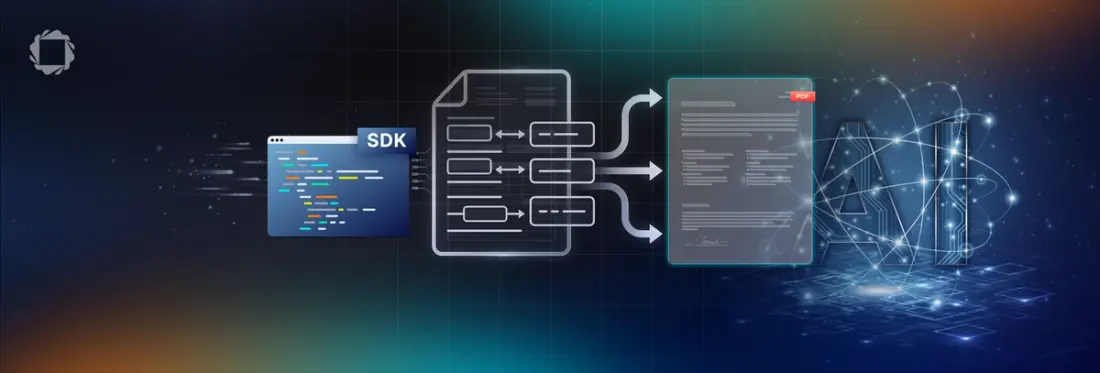
There's no single right way to extract key-value pairs from PDFs. The real work is matching the approach to your infrastructure, budget, and engineering bandwidth. This post breaks down the three main paths; cloud AI services, open-source pipelines, and commercial SDKs, and where the tradeoffs actually bite, from who handles scanned documents out of the box to who's on the hook for maintenance. If you're deciding how to build key-value extraction into your product, this is a useful map before you pick a lane.
Three approaches to extracting key-value pairs from PDFs — and where each one fits.
The Three Approaches
Extracting key-value pairs from PDFs—labels and their associated values, without a fixed template—generally comes down to one of three approaches: a cloud AI document service, an open-source pipeline, or a commercial SDK.
Cloud AI Document Services
Services like Azure AI Document Intelligence, Google Cloud Document AI, and Amazon Textract offer prebuilt and trainable models accessed via a REST API. They require no infrastructure to run, but documents are sent to a public cloud endpoint for processing, and pricing scales per page or per operation.
Open-Source Pipelines
A common open-source approach combines a PDF parsing library (for exampled, PyMuPDF), OCR (for example, PaddleOCR or Tesseract), and a layout/entity model (for example, LayoutLMv3) into a custom pipeline. This offers full control and no licensing cost, but requires assembling, tuning, and maintaining multiple components, and scanned-document support needs to be built in explicitly by combining OCR with the layout model rather than being provided as a single integrated capability.
Commercial SDKs
Commercial SDKs, including Apryse Key-Value Pair Extraction, package classification, extraction, and OCR into a single embeddable library that runs self-hosted. This trades some of the flexibility of an open-source pipeline for a maintained, integrated capability with support and predictable licensing.
| Cloud AI | Open Source | Commercial SDK (Apryse) |
|---|---|---|---|
Offline / air-gapped | No | Yes | Yes |
Scanned document support | Yes, built in | Requires combining OCR + layout model | Yes, built in |
Maintenance burden | Low (managed service) | High (multi-component pipeline) | Low (single vendor) |
Cost model | Per-page / per-operation | Infrastructure + engineering time | License fee |
Which Approach Fits
- Cloud AI: teams without a self-hosting requirement, comfortable sending documents to a third-party API, who want a managed service.
- Open source: teams with in-house ML engineering capacity who need full control over the pipeline and are prepared to maintain it.
- Commercial SDK: teams that need self-hosted, offline extraction, with scanned-document support and vendor maintenance, without building a custom pipeline.
FAQ
Do open-source tools support scanned document key-value extraction?
Yes, but it requires explicitly combining an OCR component with a layout/entity model. It is not a single built-in capability the way it is in a cloud AI service or a commercial SDK.
Is a commercial SDK the same as a cloud AI service?
No. A commercial SDK like Apryse Key-Value Pair Extraction runs self-hosted, within your own infrastructure. A cloud AI service runs on the vendor's infrastructure and is accessed via API.