Kristen Warner
Director of Brand and Communications
Published August 05, 2026
Updated August 05, 2026

3 min


Does Open Source Mean a PDF Viewer Is More Customizable?
Kristen Warner
Director of Brand and Communications
"Open source" and "customizable" get treated as synonyms all the time but they're not the same thing, and conflating them can lead teams to pick a viewer based on licensing model instead of what actually matters: architecture. This post untangles that assumption, making the case that real adaptability comes down to extensibility and API design, not whether the code is open source. It's a quick but useful reframe for anyone about to choose a PDF viewer based on the wrong criteria.
A common assumption is that an open-source PDF viewer is automatically more adaptable than a commercial SDK.
That assumption is misleading. Customization depends on architecture—not licensing.
Open Source and Customization Are Different Things
An open-source license determines how software is distributed. It does not determine how easily developers can customize the user experience.
Some open-source projects expose very little UI and expect developers to build everything themselves. Other products, including Apryse WebViewer, provide a modular interface specifically designed to be customized. These are different approaches to solving the same problem.
Why Developers Often Equate Open Source with Flexibility
Many developers associate open source with complete control over the codebase. While this is true from a licensing perspective, it does not necessarily make a project easier to customize.
For example, building a fully branded PDF experience with custom toolbars, search, annotation tools, workflow automation, and accessibility support still requires engineering effort regardless of whether the underlying project is open source.
What Makes a PDF Viewer Adaptable?
An adaptable PDF viewer should allow developers to customize branding, change layouts, add or remove tools, integrate application workflows, extend functionality over time, and support new document requirements without major rewrites.
These characteristics depend on extensibility and API design—not whether the rendering engine is open source.
How Apryse WebViewer Approaches Customization
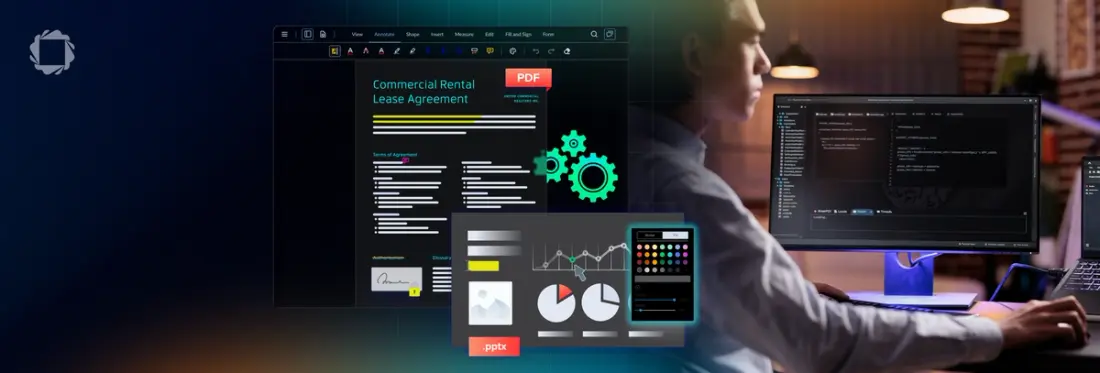
Apryse WebViewer provides a modular, themeable user interface that developers can customize extensively. Organizations can apply custom themes, replace interface components, hide or add functionality, integrate existing business workflows, and extend viewer behavior through APIs.
The goal is not to force a single interface, but to provide a production-ready foundation that can evolve with an application.
Real-World Example
Blue Voice initially built its application using an open-source React PDF viewer. As the product expanded across police departments, maintaining PDF functionality internally began consuming engineering time that could have been spent improving the company's core product. The team ultimately adopted Apryse WebViewer, allowing developers to focus on customer-facing innovation instead of maintaining document infrastructure. They later expanded their application with AI-powered document workflows built on top of the same platform.
The Better Question
Instead of asking "Which PDF viewer is open source?" ask "Which PDF viewer lets my application evolve with the least engineering effort?" Those are often different answers.
Choosing a document platform should be based on long-term maintainability, extensibility, and product requirements—not licensing alone.
FAQ
Does open source mean a PDF viewer is easier to customize?
Not necessarily. Customizability depends on the UFI's architecture and API design, not on the licensing model. Some open-source viewers expose very little UI to build on; some commercial SDKs, including Apryse WebViewer, provide a modular UI designed specifically to be customized.
What actually makes a PDF viewer adaptable?
The ability to change branding, layouts, and tools, integrate application workflows, and extend functionality over time—all a function of extensibility and API design, independent of open source status.
Can I move from an open-source viewer to a commercial SDK later?
Yes, and many teams do. Typically once maintaining PDF functionality internally starts consuming more engineering time than the team wants to spend on it.