
Smart Data Extraction at a Glance
It’s surprising that an estimated 80% of data is trapped in unstructured documents. Smart Data Extraction is the key to accessing this wealth of knowledge that has the power to shape businesses.
This guide includes topics for developers, such as the challenges of data extraction and ways to overcome them, how Smart Data Extraction works, key components to look for in a data extraction solution, and how to get started. Decision makers will find topics such as the key benefits, real-world examples, vendor considerations, and an evaluation checklist.
Here, you’ll find an in-depth look at what you need to know about accessing the data trapped in your documents to fuel your data pipeline.
Introduction: Why Smart Data Extraction Matters
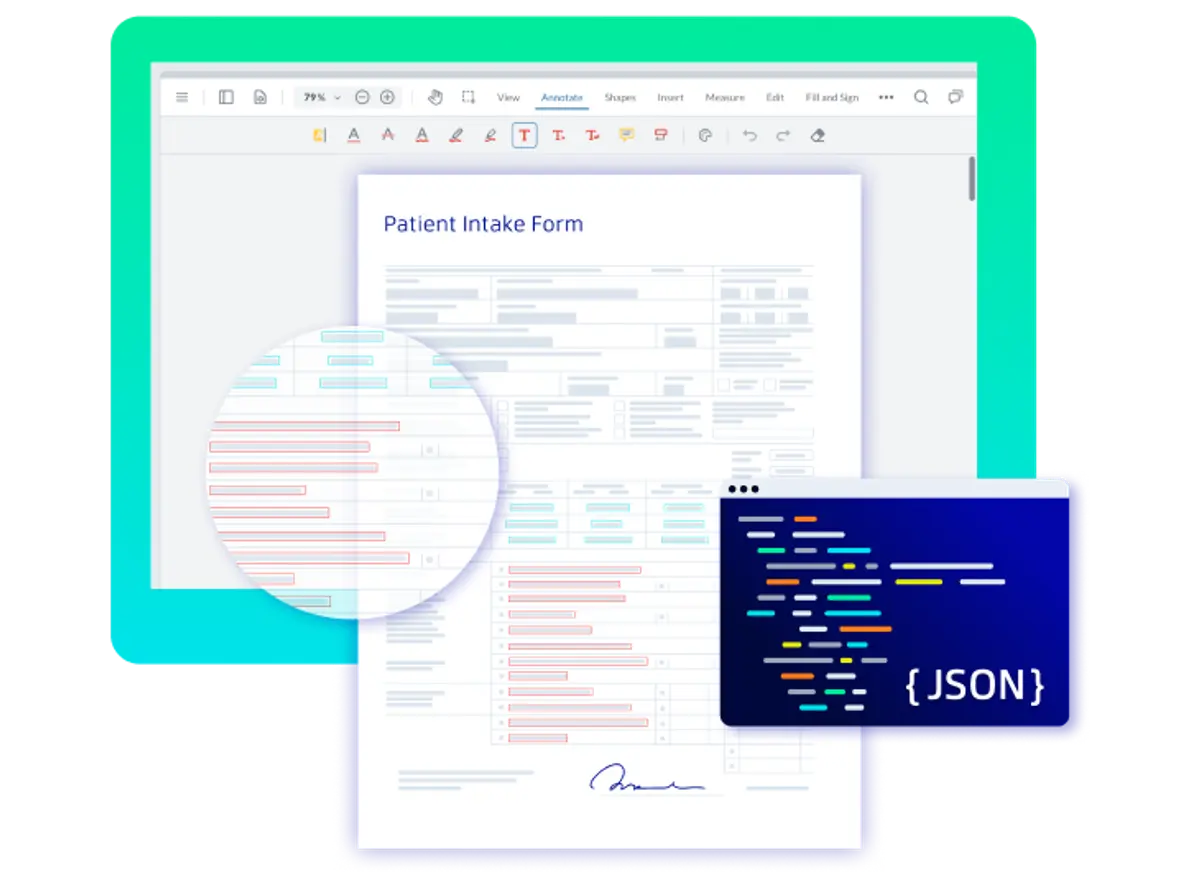
Smart Data Extraction is a powerful tool for developers who want to build an Intelligent Document Processing (IDP) solution with the goal of turning messy, unstructured documents into clean, labeled data for AI and automation workflows.
The simple matter of fact is that even though data is a critical resource that drives businesses, an estimated 80% of global data is trapped in unstructured formats like PDFs, contracts, and invoices.
By the numbers:
- 2.5+ trillion PDFs are in circulation, much of their information inaccessible.
- $3 trillion annually is the estimated cost of incorrect or incomplete data to U.S. businesses.
- 10% is the average error rate for standard invoice processing, with error correction consuming 61% of the total processing cost.
As technologies like machine learning and large language models (LLMs) become mainstream, the demand for high-quality, structured data is at an all-time high.
This guide will explore what Smart Data Extraction is, why it matters, and how to choose the right solution.
What is Smart Data Extraction? How Did It Evolve from OCR?
AI- based data extraction methods represents the next evolution of OCR, advancing the field with AI to transform how enterprises turn unstructured documents into structured, usable data. For a deeper look at how modern extraction goes beyond traditional OCR, see Smart Data Extraction beyond OCR.
At its basic level, OCR focuses primarily on using pattern recognition to convert images of text into machine-readable text. While OCR is a crucial pre-processing step for data extraction, it's only the first part of the process.
As a core component of any IDP solution, Smart Data Extraction resolves a document's structure deterministically, the same layout produces the same headers, tables, and fields every time, then applies purpose-built AI to interpret what that structure means. That pairing is what turns messy, unstructured documents into clean, labeled data AI and automation can use. It builds on the OCR foundation above by:
Interpreting Context and Meaning
It doesn't just recognize text; it understands the relationships between different pieces of information, such as identifying a value that corresponds to a specific label (a "key-value pair").
Integrating Machine Learning
Handles document layouts a rules-based system can't. Rather than matching fixed templates, it's trained to recognize patterns across diverse real-world documents, so it holds up on the variation and exceptions that break template-based extraction.
Processing Expanded Data Types
It can handle more than just text. Smart data extraction can identify and process tables, checkboxes, graphs, and other non-textual data from within a document.
Enabling Workflow Automation
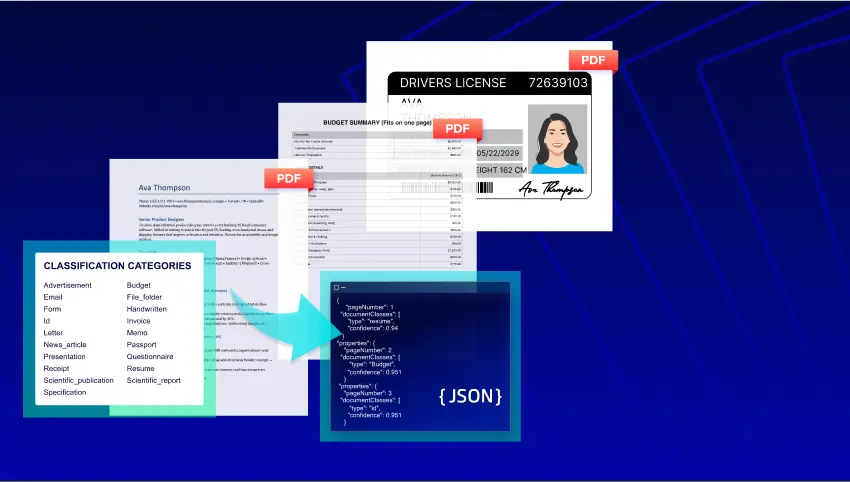
It automates the categorization and output of structured data, typically in formats like JSON, which can be seamlessly integrated into business systems, databases, and AI models.
How to Overcome Data Extraction Challenges
PDFs are notoriously difficult to extract data from due to several factors:
BUILT FOR LAYOUT, NOT STRUCTURE
PDFs are designed to display information visually to humans, not to be easily parsed by computers. The underlying objects are often complex and lack a clear, logical structure.
VARIED LAYOUTS AND FORMATS
Even documents of the same type such as invoices from different vendors can have wildly different layouts, making a single, rigid template unusable. Format variability such as structured, semi-structured, and unstructured can present its own challenges when trying to extract data efficiently.
DIVERSE CREATION METHODS
Documents can be pristine digital PDFs, scanned images of paper documents, or hybrid formats.
MANUAL EFFORT IN TEMPLATE-BASED SYSTEMS
Manually processing forms is inefficient and error prone.
FRAGMENTED TOOLSETS AND MULTIPLE VENDORS
This can lead to data silos, inconsistencies, and the need for more complex integration.
PRIVACY AND SECURITY
Keeping data safe is crucial, especially when dealing with regulations such as GDPR and HIPAA. Sensitive data must be protected during all stages of data extraction to prevent unauthorized access, use, or disclosure.

Overcoming these hurdles can be a serious challenge for organizations.
A solution must be able to:
- Extract data in usable formats.
- Meet data privacy and security requirements.
- Minimize the need for manual configuration.
- Handle diverse styles and multi-page documents.
Benefits of Smart Data Extraction
Implementing smart data extraction is more than a technical upgrade; it's a strategic move that delivers significant, measurable benefits across the organization, including:
DRIVING DATA-DRIVEN DECISIONS
By unlocking data from documents, businesses gain access to real-time insights for faster reporting and analytics. This allows for seamless data integration across business systems, empowering smarter, more connected operations.
ACCELERATING DIGITAL TRANSFORMATION
Automating workflows reduces manual data entry, making for more efficient processes while enabling businesses to scale their efforts. Effectively gathering and organizing document data digitally reveals new capabilities for continuous process improvement and automation, laying the groundwork for a truly data-driven organization.
IMPROVING ACCURACY AND PERFORMANCE
Consistent, structured data from a variety of sources enhances the accuracy of downstream systems like analytics tools and AI models. This also strengthens compliance by ensuring all captured information is clean, structured, and traceable.
ENHANCING PRODUCTIVITY
Automating the tedious task of manual data entry allows employees to focus on strategic, high-value work while streamlined workflows handle higher volumes of documents faster. The benefits of this automation grow exponentially as more document workflows are integrated into the system.
How Smart Data Extraction Works
While the technology may seem complex, the process is streamlined and logical. Here is a typical workflow based on advanced extraction technology:


Step 1: Pre-Processing
The first step is to prepare the document for extraction. This may involve applying OCR and ICR to scanned documents, normalizing file types by converting them to a single format, and redacting any sensitive data to ensure privacy. This crucial stage lays the groundwork for accurate results.






Key Capabilities to Look for in a Data Extraction Solution
FULL-FIDELITY EXTRACTION
This capability ensures the solution extracts all data and metadata from a document, preserving the original structure of tables, paragraphs, and key-value pairs.
Developers: This means a reliable and complete output (like JSON) that's easy to work with.
Decision Makers: It guarantees data integrity and higher quality information for business analytics and automation.
SUPPORT FOR ALL DOCUMENT TYPES
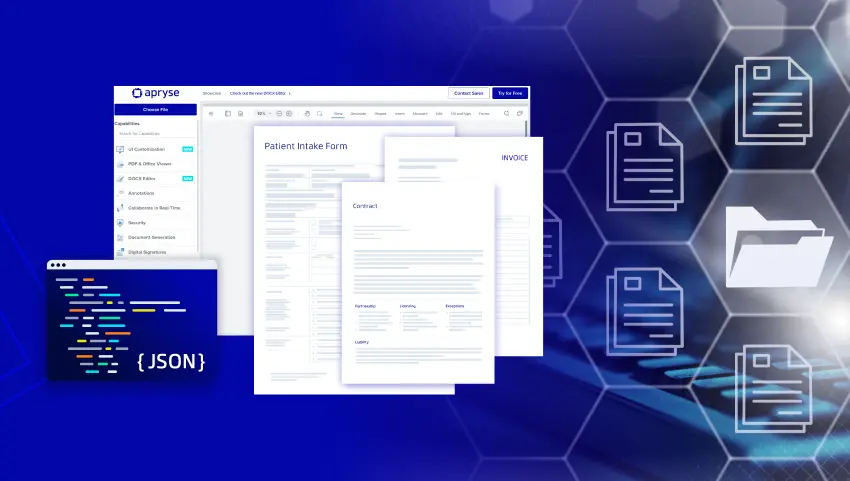
A robust solution handles structured (forms), semi-structured (invoices), and unstructured (contracts, emails) documents.
Developers: This versatility allows developers to use a single tool for multiple use cases.
Decision Makers: Automation can be applied across the entire organization, reducing the need for multiple specialized systems.
Machine Learning and AI
Smart Data Extraction pairs that structural foundation with proprietary models to interpret what the data means, not just where it sits on the page. That's context-aware extraction: recognizing that a number next to "Total Due" is a payment amount, not just a string of digits in a cell.
Developers: This enables the building of more accurate systems that handle "noisy" data.
Decision Makers: Get higher accuracy and a significant reduction in the manual effort needed to validate the data.
COLLABORATION, AUDIT TRAILS, AND COMPLIANCE
These features are crucial for enterprise adoption. Collaboration tools enable team-based workflows. Audit trails create a detailed record of every action, and provide the traceability needed for compliance with regulations like GDPR and HIPAA.
Developers: These features make it easier to build better workflows, perform debugging, and meet regulatory requirements.
Decision Makers: This means lower business risk and better accountability.
INTEGRATION FLEXIBILITY
The tool should offer modular utilities, including structure extraction, OCR, classification, key-value and table extraction, that you call individually or combine, so it integrates into your existing application without pulling in capabilities you don't need.
Developers: This means fewer potential issues implementing new solutions into existing systems.
Decision Makers: This allows for a faster time-to-market and a lower total cost of ownership by avoiding the need for extensive, custom development.
ENTERPRISE-GRADE PERFORMANCE & SCALABILITY
An enterprise-grade solution can handle high volumes of documents without performance degradation.
Developers: Constant overhauls are not required because the system can grow as the needs of the business grow.
Decision Makers: Better system reliability and availability ensures that mission-critical business processes are not interrupted.
Document Types
Selecting the right extraction technology requires an understanding of the documents you need to process. Solutions are often best suited for specific document types:
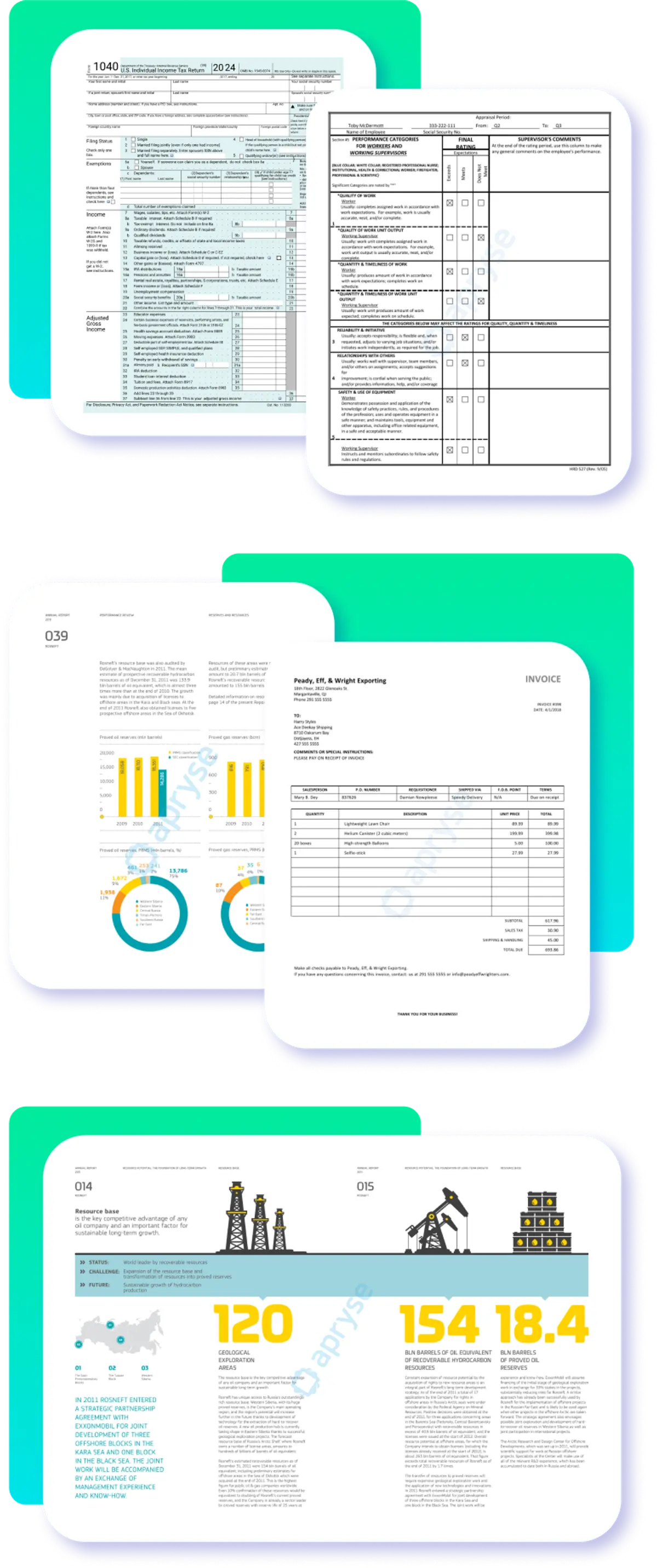
Structured Documents
Characteristics: Consistent layout and fixed format (for example, forms, surveys, payment slips).
Solution: Template-based extraction, where users define zones or coordinates for data fields.
Challenges: Creating a new template for every document type can be labor-intensive and difficult to manage as layouts change.
Semi-Structured Documents
Characteristics: Consistent data fields but variable layouts between senders (for example, invoices, purchase orders).
Solution: Requires a layout-aware tool that understands context, not just coordinates. Intelligent algorithms can identify key fields and tables across varied formats without relying on rigid templates.
Challenges: Template-based systems frequently fail with inconsistent formats, shifting fields, or non-standard terminology, leading to constant rule updates.
Unstructured Documents
Characteristics: Free-flowing, verbose content with information presented anywhere (for example, contracts, articles, memos).
Solution: The most challenging to process, requiring context-aware extraction that identifies and labels key elements such as headings, paragraphs, and entities. This relies on an understanding of context and semantics.
Challenges: Unlike forms or tables, these documents don’t follow predictable patterns, and simple keyword matching is insufficient.
Choosing a Vendor: What to Consider Before You Buy
When choosing an extraction solution, you're not just buying a product—you're entering a partnership. Consider the following vendor attributes for long-term success:
Reputation and Experience
Look for a vendor with a proven track record, experience, and a strong history of innovation.
Support and Responsiveness
Ensure the vendor provides comprehensive help resources, documentation, and live customer support.
Security and Compliance
A solution should prioritize data privacy and offer robust security measures, especially for regulated industries. Self-hosted, on-premises SDKs are ideal for maintaining full control over your data.
Scalability
The solution must be built to handle enterprise-scale workloads economically while delivering consistent performance, regardless of the volume of documents.
Flexibility and Integration
The solution should offer a robust suite of extraction methods such as forms, barcodes, OCR, tables, and more. It should also be easily integrated into your existing systems and workflows and be available in your programming language of choice.
Long-Term Roadmap
A good vendor is committed to continuous development and innovation, ensuring the solution remains relevant and future-proof.
The Apryse Advantage with Smart Data Extraction
PRIVACY-FIRST

Privacy-First
It’s a self-hosted SDK, so sensitive data never leaves your environment, which is crucial for regulated industries.
INTELLIGENT & FLEXIBLE

ALL-IN-ONE SOLUTION

DEVELOPER-FRIENDLY

SCALABLE & INTEGRATED

Real-World Examples
Smart data extraction is being used to revolutionize workflows across industries.
Healthcare
App developers can automatically extract data from patient intake forms and consent documents, speeding up EHR management, streamlining insurance claims, and enhancing clinical research while prioritizing patient privacy.
Finance
Companies can automate the extraction of data from bank statements and financial reports, accelerating fraud detection and ensuring compliance.
Customer Service
Aggregating and analyzing unstructured data from support tickets and customer emails can empower contact centers to quickly solve customer problems and improve satisfaction.
Business Intelligence & Analytics
Platforms can extract data from sources like social media and customer reviews to provide insights into market trends and customer sentiment.
Evaluation Checklist
Supports all document types
Can process PDFs, images, and various document formats with a single pipeline, reducing dev effort.
Enables automation across all business units (Finance, Legal, HR) regardless of document format, increasing efficiency.
Provides structured outputs like JSON
The API returns a predictable, machine-readable format with clear data fields and relationships, simplifying downstream automation.
Ensures data integrity and quality, providing a clean data feed for business intelligence tools and other systems.
Meets compliance standards
A solution that runs entirely on-premise, so documents and their metadata never leave your environment.
Protects the company from legal and financial risks by ensuring data handling practices align with regulations like GDPR, HIPAA, or CCPA.
Scales to enterprise workloads
The solution offers reliable performance and can handle high-volume processing with auto-scaling, preventing system bottlenecks during peak demand.
Guarantees business continuity and reliability, allowing the company to grow operations without worrying about system limitations.
Developer-friendly integration
Offers comprehensive REST APIs and well-documented SDKs in multiple languages, accelerating development and reducing time-to-market.
Lowers the total cost of ownership by reducing development time and the need for specialized IT support.
Vendor reliability & roadmap
The provider has a clear, well-supported API, responsive support channels, and a public roadmap to help with long-term planning and implementation.
Assures a long-term, stable partnership and ensures the solution will continue to evolve with emerging technology and future business needs.

How Can Developers Get Started with Smart Data Extraction in Their Apps?
Apryse Smart Data Extraction is an add-on to Server SDK, which supports Windows and Linux on desktop and server platforms.
Step 1: Get to know Smart Data Extraction
Apryse’s Smart Data Extraction transforms unstructured documents such as PDFs, scans, and DOCX files into structured, labeled JSON.
Learn more about Smart Data Extraction in our documentation.
Step 2: Explore the demo
See our demo to try Smart Data Extraction out for yourself.
Step 3: Integrate Smart Data Extraction into your application
Follow the directions in our documentation to integrate Smart Data Extraction into your application and start extracting your important data.
- Sign up for our developer portal and get your trial license key.
- Install and configure Apryse SDK.
- Download the Smart Data Extraction add-on module.
- Install the Smart Data Extraction add-on module.
- Contact our Sales Team or Discord with any questions.