
Apryse
Published June 24, 2026
Updated September 16, 2026

5 min


Building a Secure Extraction Pipeline with the Apryse Server SDK
Apryse
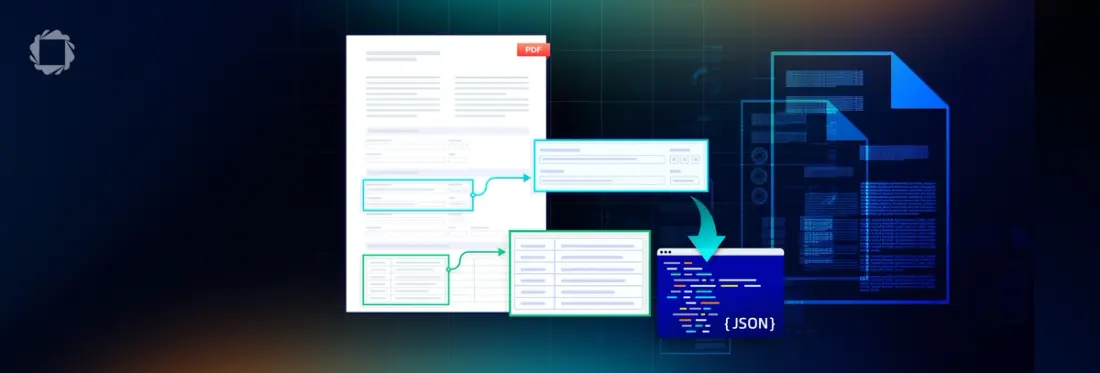
Building a secure extraction pipeline with the Apryse Server SDK means running document processing entirely inside your own infrastructure, so sensitive data never leaves your environment while still getting AI-ready structured output. The pipeline has three stages: pre-processing, extraction, and validation, all handled within the SDK rather than through external API calls.
First, the OCR engine corrects skew, rotation, and noise at the character and layout level during recognition, so scanned images and PDFs are cleaned up before extraction begins. Second, Smart Data Extraction combines OCR and ICR to pull document classification, key-value pairs, table data, and handwritten text, often without needing pre-defined templates. Third, because no automated system is perfect, the Apryse WebViewer adds a human-in-the-loop step, letting users visually review, annotate, and correct extracted data inside your application before it moves downstream. Together, these stages produce clean, labeled JSON output while keeping every step of processing on infrastructure you control.
Most business information is locked away in unstructured documents like PDFs, scans, and Office files. For enterprises and software teams turning that content into usable data is a recurring challenge. The first step is often to digitize this content, but the method you choose can mean the difference between generating high-quality intelligence and creating a “garbage in, garbage out” data pipeline. This guide explains the critical leap from basic Optical Character Recognition (OCR) to intelligent document processing (the industry term for a full extraction pipeline) and clarifies which approach is right for which use case—whether you are powering AI applications, automating back-office processes, or modernizing a document-heavy product.
What is Traditional OCR? The Foundational First Step
Optical Character Recognition (OCR) is a foundational technology that converts images of typed or printed text into a machine-readable string of text characters. Think of it as a digital transcriber that reads the words on a scanned page and outputs a simple text file. This technology was a breakthrough for digitizing archives and enabling basic search on previously unsearchable documents.
For many years, OCR was the primary tool for document digitization. It is effective for:
- Basic digitization of paper archives.
- Enabling full-text search on scanned documents and images.
However, for the nuanced demands of modern AI, traditional OCR has severe limitations. Its output is essentially a “wall of text,” a flat file of characters with no deeper understanding of the document’s meaning or structure. The risks of relying solely on OCR for an AI workflow are significant.
- Output is unstructured: OCR produces raw text without recognizing critical layout elements like tables, columns, key-value pairs, or form fields.
- Context is lost: It cannot differentiate between an invoice number and a date, or a header and a footer. The semantic relationships between data points are completely lost, making the data unreliable for automated decision-making.
- Fragile and template-dependent: Many traditional OCR systems rely on rigid templates. They break as soon as a document’s layout changes, forcing developers into a costly cycle of re-engineering and maintenance.
For an AI model, the raw, context-free text from traditional OCR is little more than noise. It lacks the structure and meaning required for high-level analysis, leading to inaccurate results and failed automation.
What is Intelligent Document Processing (IDP)? The AI-Powered Evolution
Intelligent Document Processing (IDP) is the modern evolution of OCR. It is not a single technology but a comprehensive data extraction pipeline that uses OCR as just one component, augmenting it with advanced AI like machine learning (ML), computer vision, and natural language processing (NLP). IDP moves beyond simple character recognition to achieve true document understanding.
While traditional OCR simply reads, IDP comprehends. It analyzes a document holistically to extract not just the text, but also its context, structure, and meaning.
The core capabilities of an IDP system include:
- Document Classification: Automatically identifying the document type, such as an invoice, contract, or purchase order.
- Smart Data Extraction: Identifying and extracting specific data points like key-value pairs (e.g., “Invoice Number: INV-123”), complex and nested table data, and form fields, often without needing pre-defined templates.
- Layout & Structure Analysis: Understanding the document’s visual and logical hierarchy, including headings, paragraphs, lists, and footers.
- Intelligent Character Recognition (ICR): Recognizes and transcribes handwritten text from forms and documents. Apryse ICR runs alongside OCR in the Server SDK.
The critical difference is the output. IDP delivers clean, structured, and labeled data—typically in a JSON format—that is perfectly suited for AI models and automated workflows. This is the key to making documents truly AI-ready.
Why Modern Workflows Demand Structured Intelligence, Not Just Text
Modern AI pipelines, particularly systems using Retrieval-Augmented Generation (RAG), depend on high-quality, contextual data to function effectively. A raw text dump from OCR lacks the metadata and structure needed for reliable information retrieval and logical reasoning. When an AI model receives unstructured text, it has no way to know if a number is part of a price, a quantity, or a ZIP code.
Structured JSON output from an IDP system preserves these critical relationships. An LLM can understand that a specific line item belongs to a table, which is located on an invoice from a particular vendor. This contextual understanding is impossible with a simple text file.
Relying on basic OCR forces developers into a costly trap: writing and maintaining an army of complex, brittle parsers to try to make sense of the unstructured text. This “data tax” is inefficient, scales poorly, and introduces a significant risk of error. A robust IDP solution eliminates this burden by delivering data that is immediately usable. At Apryse, we give developers the tools to convert unstructured PDFs into clean, labeled JSON, purpose-built for AI agent development and RAG workflows.
Building a Secure Extraction Pipeline with the Apryse Server SDK
Apryse provides a complete document SDK solution that empowers developers to build custom, high-performance IDP capabilities directly into their applications. Instead of a rigid, black-box application, we provide the flexible building blocks to construct a secure pipeline that meets your exact needs, with all processing happening inside your own infrastructure.
Start with High-Fidelity Pre-processing
Reliable data extraction starts with high-quality input. The Apryse OCR engine applies internal image processing during recognition - correcting skew, rotation, and noise at the character and layout level so that the text extracted from scanned image PDFs and images is as accurate as possible before it ever reaches your downstream pipeline. This AI-driven correction step is part of what separates AI OCR from a purely template-matching engine.This means you get cleaner output without any modification to your source documents.
Extract Structured Data with AI-Powered Intelligence
With a clean document, you can proceed to extraction. Apryse’s OCR and ICR capabilities are integrated into a powerful, AI-driven extraction engine. Using our Server SDK, developers can build a extraction pipeline using Smart Data Extraction to capture:
- Document Classification for categorizing documents
- Key-value pairs without templates
- Complex and nested table data
- Document structure (headings, paragraphs, lists)
- Handwritten text via our ICR engine
Crucially, the Apryse Server SDK runs entirely on-premise or in your private cloud. No external API calls are needed for extraction. Your sensitive data never leaves your environment, ensuring maximum security and compliance for mission-critical workflows.
Validate and Review with Human-in-the-Loop (HITL) Workflows
No automated system is perfect. For workflows requiring 100% accuracy, building a human-in-the-loop (HITL) validation step is an essential risk mitigation strategy. The Apryse WebViewer is a powerful client-side component that allows you to embed a UI directly into your application for this purpose. Developers can use it to create intuitive interfaces where users can visually review, annotate, and correct extracted data, ensuring only verified information is passed to downstream systems or used for AI model training.
Your Toolkit for AI-Ready Document Workflows
The path to effective AI-powered automation starts with the right data. While traditional OCR digitizes text, it falls short of providing the structured intelligence that modern AI document processing requires. Structured extraction bridges this gap by transforming unstructured documents into clean, labeled, and context-rich data.
The Apryse Server SDK and WebViewer provide a complete developer toolkit for building secure, high-performance extraction pipelines. By giving you control over every step—from pre-processing and extraction to human validation—we empower you to build smarter, easier, and faster document workflows that are truly AI-ready.
Explore Smart Data Extraction to see these capabilities in action or start your free trial to build your first AI-ready document pipeline today.



Ready to get started?
Sign up for a free trial to begin implementing the Apryse SDK in your application!
