JavaScript SDK for Viewing and Editing XLSX, XLS, and CSV in the Browser
Spreadsheet Editor renders XLSX, XLS, and CSV files in the browser, preserves their formulas, cell styling, and charts, and exposes a JavaScript API to drive it programmatically. If you already run WebViewer, the Apryse Web SDK, the add-on activates as soon as a spreadsheet file loads.
A Spreadsheet Interface Your Users Already Know
Spreadsheet Editor. gives you an Excel-compatible grid for XLSX, XLS, and CSV files, with over 260 formulas and full cell formatting, processed entirely client-side.
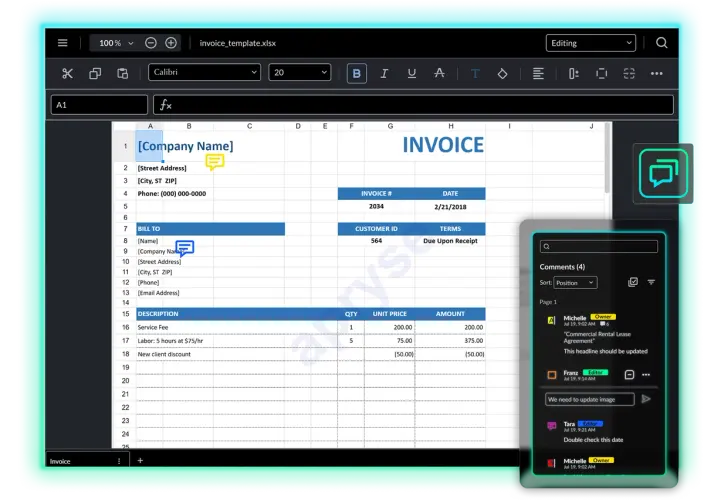

Familiar Spreadsheet Grid
Spreadsheet Editor opens XLSX, XLS, and CSV files in a grid interface, with no Excel installation required.

Formulas and Formatting
The grid supports over 260 Excel functions, covering math, statistics, date and time, text, logical, lookup, financial, and engineering categories.

Client-Side Processing
Spreadsheet Editor renders and edits the file entirely in the browser. No server round trip is required to open, edit, or save it.

WCAG 2.2 Level AA Compliant UI
The editor interface meets WCAG 2.2 Level AA, along with every editor UI in the Web SDK.
Read-Only Viewing and Full Editing

Read-only Viewing
Read-only viewing is the common starting point for finance, audit, and compliance portals, where a user needs to inspect a generated report inside the app without making changes. Spreadsheet Editor opens in View mode by default. Users navigate the grid, move between sheets, and inspect formulas alongside calculated results, without altering the file.
Full Editing
Editing gets enabled as needed. Edit mode enables the full toolset with cell-level formatting: fonts, colors, borders, bold, italic, underline, and strikethrough. It is activated from your code, so a single integration covers both review and revision workflows.
See the Edit mode guide for full details.
React, Angular, Vue, Next.js, and More
Spreadsheet Editor runs client-side, so it drops into the front-end you already have. Mount it to a DOM element in React, Angular, Vue, NuxtJS, or Next.js, or Svelte. For a worked example, see view and edit spreadsheets in React. It also deploys inside Salesforce, Appian, Mendix, or OutSystems. It shares the same API and UI framework as the Web SDK’s editing add-ons.



Add Spreadsheet Editing with No Extra Configuration
Point initialDoc at your file, or leave it out and start from a blank workbook.
You can instantiate the editor as a Web component, and it supports custom HTTP headers when your file requests need them.
Pass an XLSX, XLS, or CSV to initialDoc and the editor takes it from there. XLS and CSV convert to XLSX in the browser on load, so all three formats follow the same path, and the source file in your storage is not modified. See XLS and CSV support in Spreadsheet Editor.
Alternatively, touch the workbook from code.
If WebViewer is already in your project, there is nothing to configure. Spreadsheet Editor activates on its own when an XLSX, XLS, or CSV file loads with the add-on license.
Trusted for document workflows where data control and formatting fidelity matter








Spreadsheet Editor at a Glance
Spreadsheet Editor runs as an add-on to the Apryse Web SDK, so the workbook is parsed and rendered locally and never sent to a third-party service.
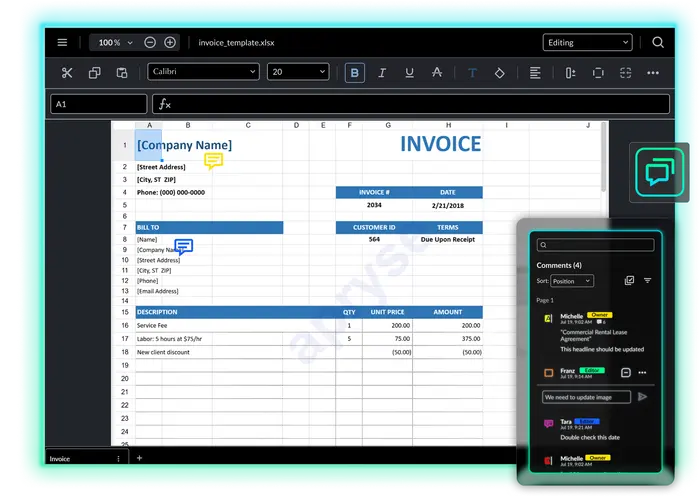
Deployment and Integration
Spreadsheet Editor runs in the browser as part of the Apryse Web SDK.
How Client-Side Spreadsheet Editing Works
Spreadsheet Editor runs entirely client-side on WebAssembly: nothing is uploaded, and there is no server round-trip for spreadsheet operations. Apryse holds SOC 2 certification and ISO 27001.
File Support
XLS and CSV are converted to XLSX on import.
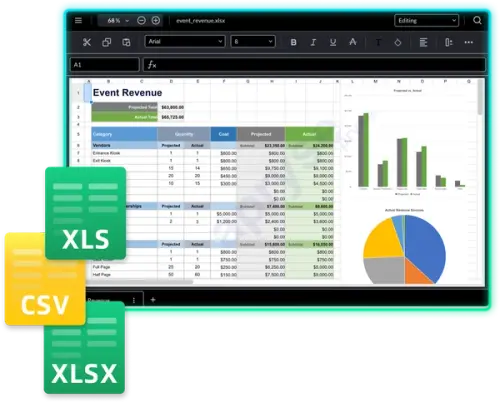
Customization
Once the editor signals ready, you drive everything through the JavaScript API: mode switching, edits, formatting, search and replace, and export.
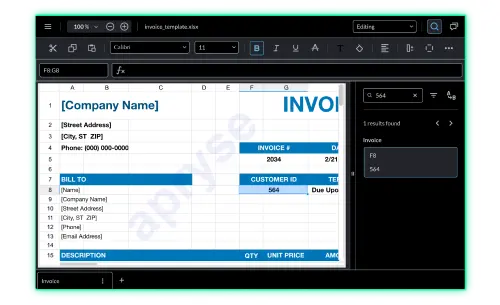
Client-Side Processing
The file is read into browser memory and processed there. Spreadsheet Editor makes no network call to Apryse.

Export Output
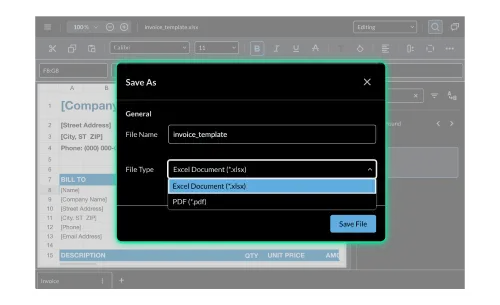
Exported XLSX and PDF files are generated in the browser and handed back to your application.
When to Consider Spreadsheet Editor
Excel-like Workflow
You want an Excel-like environment without embedding a full office suite or routing files through a cloud service.
Data Security
When your users need to open and edit spreadsheets inside your app, with no data leaving the browser.
Step-by-Step Tutorial for Building a React Spreadsheet Editor with Apryse
In this step-by-step tutorial, we’ll show you how to: - Scaffold a Vite + React + TypeScript project - Install and configure Apryse WebViewer - Enable spreadsheet editing mode - Load and edit XLSX files in the browser - Fix common styling issues - Use plugins like vite-plugin-static-copy
Spreadsheet Editor Alternatives:
How Four Approaches Compare
Adding spreadsheets to a web app usually comes down to four options: an embedded cloud office service, a full self-hosted office editor, a JavaScript grid, or building the surface yourself. Here’s how a client-side editor compares.
Over an embedded cloud office service
A cloud service sends the file to infrastructure you do not control, and every edit is a network round-trip. Spreadsheet Editor keeps the file in the browser. For apps handling sensitive financial or regulated data, that is often the deciding factor. Per-page and per-transaction pricing also compounds as volume grows, where Spreadsheet Editor is licensed flat with no per-page fee.
Over a full self-hosted office editor
A full editor gives you a broad feature set, but it also brings a server to run and more interface than most embedded workflows need. Spreadsheet Editor is scoped to spreadsheet viewing and editing, so there is less to deploy and less to strip back. Editors in this category run a document server on Docker or Kubernetes, which you provision, scale, and patch. Spreadsheet Editor has no server component at all.
Over a JavaScript grid
A data grid treats content as grid rows rather than a spreadsheet file, so formulas, cell formatting, and charts from the original XLSX file are lost or rebuilt by hand. Spreadsheet Editor reads and writes the real file.
Over building it yourself
Rolling your own means owning file parsing, formula evaluation, formatting, chart rendering, and export. Spreadsheet Editor gives you that as a supported component. The tradeoff is a license cost against the engineering time to build and maintain it.
Where Developers Use a Spreadsheet Editor SDK
Spreadsheet Editor is well-suited for portals, financial applications, banking apps, and compliance tools where users work with XLSX, XLS, or CSV data that should stay in the browser.


Client and deal portals
Embed proposal review so users open Excel-based proposals in-app, with the file staying in the browser.
Financial reporting apps
Render generated reports for in-app review and edits, so users do not export to a separate spreadsheet tool.
Compliance and onboarding flows
Embed checklist and declaration templates for in-app editing, without downloads or format loss.
Read-only audit and review
Present generated statements or audit workbooks in View mode, so reviewers inspect formulas and results with no ability to alter the file.
Documentation and Resources
Documentation
- Spreadsheet Editor: Overview
- Spreadsheet Editor: Basic Setup
- View Mode Guide
- Edit Mode Guide
- Interactive Demo
Related Capabilities
Guides and further reading
- 2026 Fall Release: Spreadsheet Editor Comments
- 2026 Summer Release: XLS and CSV Support
- Spreadsheet Editor Use Cases
- Automatic File Type Detection for PDF, DOCX, and XLSX
- JavaScript Spreadsheet Editor SDK: Embed XLSX Editing in Your Web App
- View and Edit Spreadsheets in React with the Apryse SDK
- A Secure, Read-Only Spreadsheet Viewer for Finance Apps
- Customizing the Spreadsheet Editor API
- Search and Replace in Spreadsheet Editor
- JavaScript DOCX and Spreadsheet Editing in Web Apps
- Spreadsheet Editor Chart Support
- Client-Side Spreadsheet Support in the Apryse Editor
